EU Packaging Regulation (PPWR) 2026: Importing Private-Label Goods from Japan
Contents
Short answer: As of October 2026, the Packaging and Packaging Waste Regulation, Regulation (EU) 2025/40 (PPWR), has applied since 12 August 2026 and has replaced the 1994 Packaging Directive. Most design rules start later. The harmonised sorting label comes no earlier than 12 August 2028. Recyclability grades and the 50% empty-space limit for shipping packaging come no earlier than 1 January 2030. If Japanese-made products are sold in packaging under your brand, the PPWR treats you as the manufacturer of that packaging. You are usually also the importer, and you are the producer for extended producer responsibility (EPR) in each country where you first make the goods available.
Which dates apply to what
| Date | What applies |
|---|---|
| 11 February 2025 | Regulation in force |
| 12 August 2026 | General application. Directive 94/62/EC repealed, with some provisions kept for a transition period |
| 12 February 2028 | Empty space in sales packaging reduced to the minimum needed for its function, including protection (Art. 24(4)) |
| 12 August 2028, or 24 months after the Commission’s implementing acts if later | Harmonised label showing material composition, for consumer sorting (Art. 12(1)) |
| 1 January 2030 | Packaging weight and volume reduced to the minimum needed (Art. 10(1)) |
| 1 January 2030, or 3 years after the implementing acts if later | Maximum 50% empty-space ratio for grouped, transport and e-commerce packaging (Art. 24(1)) |
| 1 January 2030, or 24 months after the delegated acts if later | Packaging must be recyclable within grade A, B or C (Art. 6) |
| 1 January 2038 | Grade A or B only |
The “whichever is later” dates depend on Commission acts. Check whether they have been adopted before you plan around a date. The Regulation also limits lead, cadmium, mercury and hexavalent chromium in packaging and its components to a combined 100 mg/kg (Art. 5(4)).
Who you are under the PPWR
Manufacturer. If you have packaging or a packaged product designed or made under your own name or trademark, the Regulation treats you as its manufacturer, even when a Japanese factory made it (Art. 3(1), point 13). There is an exception for micro-enterprises, but only when the packaging supplier is in the same Member State, so it does not help with packaging that comes from Japan.
Importer. An importer is anyone established in the EU who places packaging from a third country on the market. Packaging on goods made in Japan counts.
Producer (for EPR). A business established in a Member State is a producer if it is the first to make packaged products available on that country’s territory. So is a business that sells directly to end users in another Member State.
What the manufacturer and importer must do
As manufacturer (Art. 15), you must:
- carry out the conformity assessment, draw up the technical documentation (Annex VII) and an EU declaration of conformity
- keep both for five years for single-use packaging
- make sure the packaging carries a type, batch or serial number, or equivalent identification
- put your name, registered trade name or trademark, and a postal address on the packaging. Where that is not possible, use a QR code or other data carrier, or an accompanying document
As importer (Art. 18), you must check that the manufacturer has done the above. You also put your own name and contact address on the packaging, and keep the declaration of conformity available for the authorities. As both manufacturer and importer, you do both.
The requirements the documentation has to show (Articles 5 to 12) have their own dates, so what you must prove grows as the later dates arrive. The Commission has published guidelines (March 2026) and FAQs (August 2026) on its packaging page.
EPR: registration in each country
- Register in every Member State where you first make packaged products available. You may not sell there until you, or where allowed your authorised representative, are registered (Art. 44(2) and (4)).
- New national registers are being set up on a common EU format. Member States have 18 months after the Commission’s implementing act to adapt or create them. Until then, the Commission says you must keep following each country’s existing EPR registration rules.
- Report yearly, by 1 June for the previous calendar year. Producers below 10 tonnes of packaging a year in a country report a shorter set of data (Art. 44(7) and (8)). The Commission notes that Member States may also give small producers lighter fees and procedures.
- Selling direct to consumers in another Member State requires an authorised representative for EPR in that country (Art. 45(3)). In December 2025 the Commission proposed suspending this for small businesses. While Parliament and Council examine the proposal, it has asked Member States to enforce the requirement pragmatically and not to sanction operators. As of October 2026 the obligation is still in the Regulation.
- Online platforms will ask for your registration number once the new registers exist.
Planning packaging made in Japan
- Get a material breakdown for every component (box, tray, insert, film, tape, label) with weight per unit. You need it for EPR reports by material, and later for the sorting label.
- Ask about inks and coatings on printed boxes, with test data if the maker or printer has it, for the 100 mg/kg heavy-metals limit.
- Leave space on the box or label for your name and address, or plan a QR code.
- Design new packaging with 2030 in mind. Article 10 requires minimal weight and volume. It also bars features that only make a product look bigger, such as double walls and false bottoms, with narrow exceptions for protected designs. Check in the guidelines when each part applies.
What this means if you order through me
I ask the maker, in writing, for the material and weight of every packaging component, and for any ink or material test data. I pass it to you as received, for your technical documentation and EPR reports. If something is not available, I tell you before you approve the pre-production sample. I am in Japan, so I cannot register you or act as your EU authorised representative. You need someone established in the EU for that. This article is an explanation, not legal advice. Check with the EPR scheme and competent authority in each country where you sell.
Related: custom paper boxes, OEM, ODM and private label, and origin labels. See private label and how it works, or send a brief.
Sources
- EUR-Lex, Regulation (EU) 2025/40 on packaging and packaging waste: eur-lex.europa.eu/eli/reg/2025/40/oj
- European Commission, Packaging waste: environment.ec.europa.eu/topics/waste-and-recycling/packaging-waste_en
- European Commission, Extended producer responsibility for packaging for Small Businesses: environment.ec.europa.eu/topics/waste-and-recycling/packaging-waste/extended-producer-responsibility-packaging-small-businesses_en
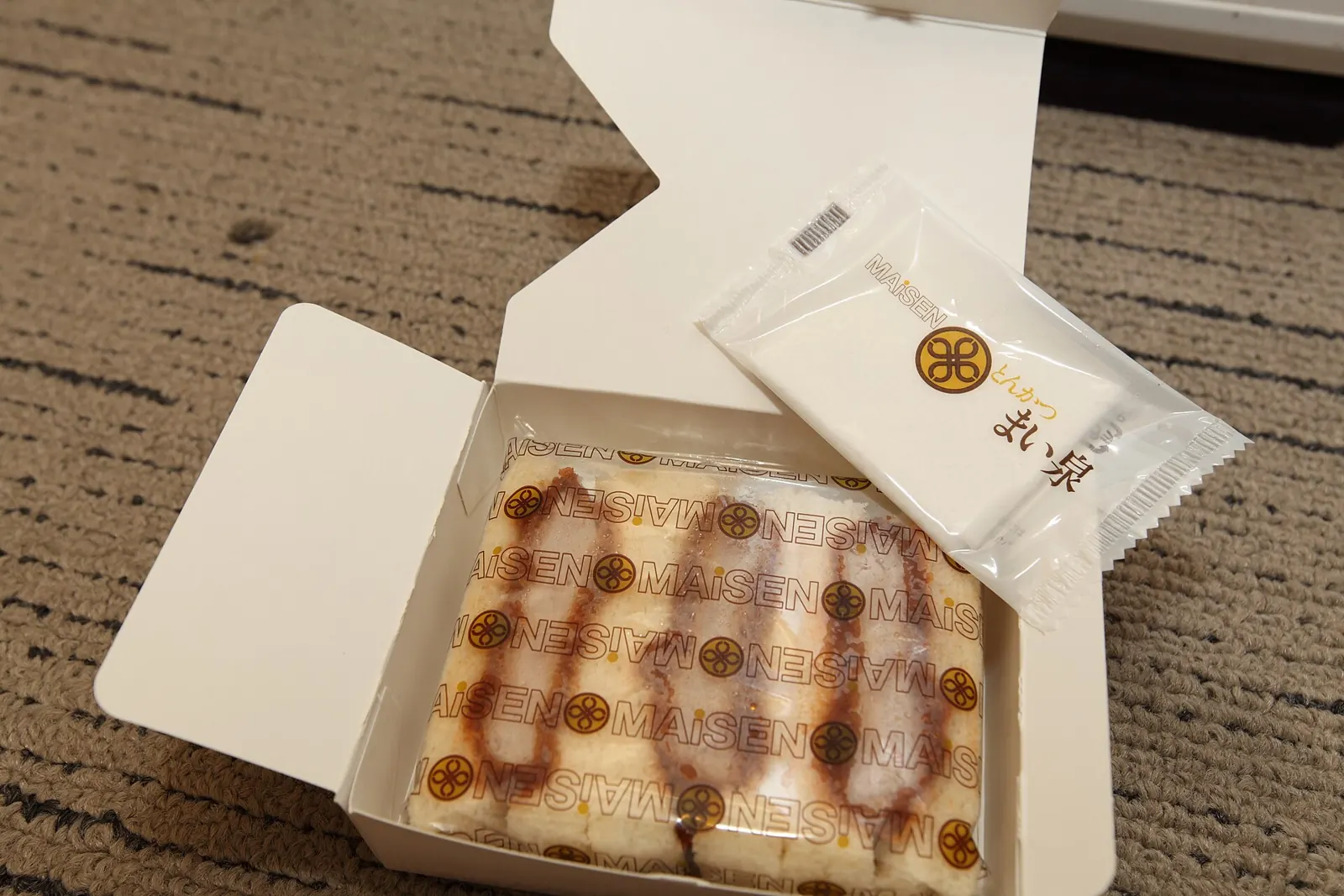
Top photo: “まい泉 (8352540600)” by 思弦 張, CC BY 2.0, via Wikimedia Commons. Resized and cropped. ↗ CC BY 2.0