Custom Tenugui: Japanese Cotton Cloths Printed or Dyed with Your Design
Contents
Short answer: A tenugui is a thin, flat-woven cotton cloth, usually about the length of a forearm and a half, with unhemmed ends. Custom tenugui are one of the easiest Japanese textiles to make under your own design: either printed, or hand-dyed by the chusen method, where dye is poured through stacked layers of cloth.
What a tenugui is
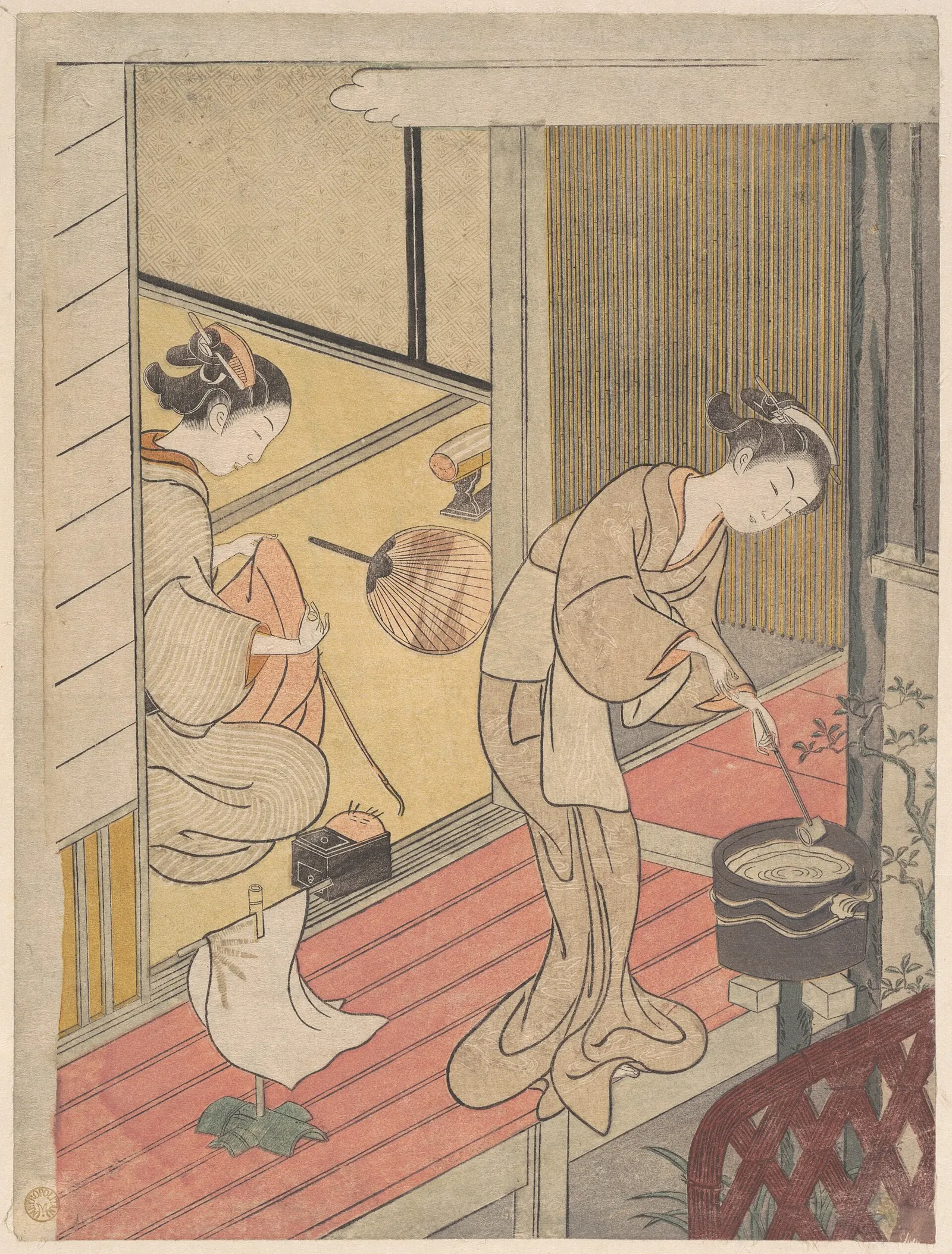
Tenugui have been used in Japan for centuries as hand towels, headbands, wrapping cloths and decoration; they appear in many Edo-period prints. Unlike a pile towel, a tenugui is a plain-weave cotton cloth. It dries quickly, softens with washing, and its cut ends are left unhemmed on purpose so they dry fast and fray only slightly at first.
Today they are sold as souvenirs, gift wrap, kitchen cloths and wall hangings, and shops and brands commission them with their own patterns.
Two ways to make a custom tenugui
Printing
The design is printed onto the cloth, usually by screen printing. It suits sharp graphics, logos and many colours, and small quantities are often easier than with hand dyeing.
Chusen (注染) hand dyeing
Chusen means “poured dye”. Cloth is folded in long stacks, a resist paste is applied through a stencil, and dye is poured through the stack, so the colour goes right through the cloth and both sides look the same. The colours bleed softly at the edges and can be blended into gradations. Hamamatsu, among other places, is known for this technique. Every piece is slightly different, which is the point.
| Printing | Chusen dyeing | |
|---|---|---|
| Look | Crisp, exact | Soft edges, gradations, both sides coloured |
| Colours | Many colours possible | Usually a few colours per design |
| Setup | A screen per colour | A stencil per design |
| Feel | The print sits on the surface | The cloth stays soft; colour goes through |
What to send a maker
- Your design, with the colours marked
- Whether you want printing or chusen, or a recommendation
- Size (most makers have a standard length and width)
- Quantity, and how you want them packed (folded, in a sleeve, with a card)
Questions to ask
- What is the standard size and cotton quality?
- How many colours can the design have, by each method?
- Is the stencil or screen a one-off cost, and is it kept for reorders?
- How much will the colours vary from piece to piece with chusen?
Tenugui are covered on the towels and textiles page. If you want me to ask Japanese dye works and printers for you, send a brief.
Sources
- Explore Shizuoka, Chusen dyeing at a Hamamatsu workshop: exploreshizuoka.jp/en/blog/meet-the-locals/discover-the-traditional-japanese-art-of-chusen-some-dyeing-at-nihashi-somekoujyo-in-hamamatsu/
- iN Hamamatsu, The traditional dyeing technique Hamamatsu chusen: www.inhamamatsu.com/culture/chusen-dyeing.php
Top photo: “MET DP119523” by Suzuki Harunobu, CC0, via Wikimedia Commons. Resized and cropped. ↗ CC0