Sending Samples from Japan in Late 2026: What Changed at Japan Post This Year
Contents
- What changed in 2026
- Small samples: Air Packet, not registered small packet
- The customs form changed
- The United States: prepaid duties for almost everything
- Middle East, Europe and Africa: delays
- EMS rates from 1 February 2027
- When a courier is better
- Duties at the other end, briefly
- What I do when I send you a sample
Short answer: Samples still leave Japan by post, but the options changed in 2026. Registered small packets ended on 31 December 2025, so a tracked sample under 2 kg now goes by International Air Packet or EMS. Mail to the United States now needs duties prepaid through an approved app for almost everything. Mail to the Middle East, and some mail to Europe and Africa, is slow because of flight disruption. EMS rates rise on 1 February 2027. Everything below is as of October 2026; Japan Post updates these pages often.
For the basics of post, courier and freight, see Shipping small lots from Japan. This post covers what is new.
What changed in 2026
| Change | Date | What it means for a sample |
|---|---|---|
| Registered small packets ended | 31 Dec 2025 | A small packet can no longer be registered |
| International Air Packet open to all destinations | 1 Jun 2026 | The tracked option up to 2 kg (formerly “e-Packet Light”) |
| New customs form (CN22/23) categories | 1 Jun 2026 | Tick “Commercial goods (BtoB)” for business shipments |
| Goods for sale cannot go as printed matter | 1 Jun 2026 | Documents are fine; saleable books and cards are not |
| US: prepaid duties for almost all mail with goods | 15 Oct 2026 | Even a free sample needs pre-registration |
| EMS rates rise; weight steps of 1 kg up to 6 kg | 1 Feb 2027 | A 500 g sample costs the same as 1 kg |
Small samples: Air Packet, not registered small packet
Until the end of 2025, a light sample could go as a registered small packet. Japan Post ended registered handling for small packets on 31 December 2025, following a change to the Universal Postal Convention. A plain small packet (up to 2 kg) still exists, but Japan Post’s own page says it is not recorded and recommends International Air Packet if you need a record.
International Air Packet is airmail for items up to 2 kg, delivered to the mailbox, with tracking. It replaced the old e-Packet Light name on 1 June 2026 and was opened to all destinations, except those temporarily suspended because of flight cuts. Japan Post warns that tracking may not be available in some destination countries. Labels must be made through Japan Post’s online My Page service; handwritten labels are not accepted.
The customs form changed
From 1 June 2026 the customs declaration (CN22/23) is printed in English and Japanese and has new categories, including “Commercial goods (BtoB)” and “E-commerce goods”. Japan Post asks senders to pick the category that matches the real purpose. Separately, goods with commercial value can no longer be sent as printed matter; that service is for documents. Documents that are not for sale can still go as printed matter. From 1 January 2027, letters and printed matter are limited to 1 kg and 3 cm thick, so a heavy or thick catalogue will have to go as a small packet instead.
The United States: prepaid duties for almost everything
This is the biggest change for US buyers. After the US ended the duty exemption for low-value postal imports in August 2025, Japan Post stopped accepting US-bound mail containing goods for sale or gifts over US$100, then reopened in April 2026 for senders who prepay duties through an approved provider.
From 15 October 2026, Japan Post accepts US mail at all post offices again, but almost every item containing goods up to US$2,500 must be pre-registered with US Customs through an approved app (Japan Post names Zonos and SafePackage), and the label must show “DDP” with a 13-digit declaration number. This now includes gifts and documents of US$100 or less, which were exempt before. The provider charges a fee even when no duty is due. Items over US$2,500 do not go through the app; duty is charged at destination.
In practice, a free sample to the US now needs the same pre-registration as a paid order.
Middle East, Europe and Africa: delays
On 2 March 2026 Japan Post asked senders to hold back mail to thirteen Middle East destinations, including the United Arab Emirates, Israel, Saudi Arabia, Turkey and Egypt, because of flight cancellations. Its 7 October update says the disruption has also congested flights and ships to parts of Europe and Africa, so mail there is still slow, and some accepted items may have to be returned.
Japan Post’s acceptance table of 15 October 2026 shows airmail and EMS accepted for Israel, Norway and Greece, but SAL (economy air) is not offered to most destinations. Check the table for your country on the day you ship; it is updated every few weeks.
EMS rates from 1 February 2027
Japan Post will revise international rates on 1 February 2027. Below 6 kg, EMS will be charged in 1 kg steps, and the special surcharge on EMS and air parcels goes to zero. Current and new prices for an EMS item up to 1 kg:
| Destination | Now | From 1 Feb 2027 |
|---|---|---|
| Europe, Canada, Oceania, Middle East (zone 3) | ¥4,400 | ¥5,100 |
| United States (zone 4) | ¥5,300 | ¥7,400 |
| Asia excluding China, Korea, Taiwan (zone 2) | ¥3,150 | ¥3,800 |
If a sample can go before February, it will cost less.
When a courier is better
- Destinations with route disruption, where post is slow or may be returned.
- Urgent samples, or a pre-production sample you must approve by a date.
- Higher values, where you want one carrier’s tracking and insurance end to end.
- Goods restricted by post but accepted by couriers under their own rules.
Couriers cost more and have their own rules for batteries, blades and liquids, so I compare both before I ship.
Duties at the other end, briefly
Two rule changes affect low-value parcels: the EU removed its €150 duty exemption on 1 July 2026 and applies a flat €3 duty to low-value e-commerce parcels, and the US ended its low-value exemption for postal imports in 2025. Both are covered in detail elsewhere; ask your customs broker or postal service before you rely on either.
What I do when I send you a sample
- I check Japan Post’s conditions for your country, and the acceptance table, before I quote, not after.
- I choose Air Packet, EMS or a courier by weight, value, urgency and route, and tell you which and why.
- For the US, I pre-register the shipment and prepay duties through the approved app, and include that cost in the quote.
- I describe the goods plainly and declare their real value, even for a free sample.
- Sample handling and dispatch is €25 per shipment plus carriage (How it works).
If you need a sample from a Japanese maker before February, send me a brief.
Sources
- Japan Post, Registered mail (Japanese): www.post.japanpost.jp/service/send/oversea/list/option/registered.html
- Japan Post, Small packet (Japanese): www.post.japanpost.jp/service/send/oversea/list/delivery/small_packing.html
- Japan Post, International Air Packet (Japanese): www.post.japanpost.jp/service/send/oversea/list/delivery/airpacket.html
- Ministry of Internal Affairs and Communications, Approval of changes to the international postal terms (Japanese): www.soumu.go.jp/menu_news/s-news/01ryutsu15_02000055.html
- Japan Post, Customs declaration (CN22/23) form revision, 27 March 2026 (Japanese): www.post.japanpost.jp/service/send/oversea/information/2026/0327_01.html
- Japan Post, Goods for sale cannot be sent as printed matter, 13 May 2026 (Japanese): www.post.japanpost.jp/service/send/oversea/information/2026/0513_01.html
- Japan Post, Resumption of acceptance of mail to the United States (Japanese): www.post.japanpost.jp/service/send/oversea/information/2026/0413_01.html
- Japan Post, Expansion of acceptance of mail to the United States, 14 October 2026 (Japanese): www.post.japanpost.jp/service/send/oversea/information/2026/1014_01.html
- Japan Post, Suspension of mail to the Middle East, 2 March 2026 (Japanese): www.post.japanpost.jp/service/send/oversea/information/2026/0302_01.html
- Japan Post, Delays to Europe and Africa (update 4), 7 October 2026 (Japanese): www.post.japanpost.jp/service/send/oversea/information/2026/1007_01.html
- Japan Post, Acceptance by destination as of 15 October 2026 (PDF, Japanese): www.post.japanpost.jp/service/send/oversea/information/overview.pdf
- Japan Post, EMS rates (Japanese): www.post.japanpost.jp/send/oversea/charge/list-ems/all.html
- Japan Post, International rate revision from 1 February 2027 (Japanese): www.post.japanpost.jp/service/send/oversea/information/fee_revision_2027/
- Japan Post, New rate table from 1 February 2027 (PDF, Japanese): www.post.japanpost.jp/service/send/oversea/information/fee_revision_2027/charges.pdf
- Japan Post, EU removal of the EUR 150 duty exemption, update 4 (Japanese): www.post.japanpost.jp/service/send/oversea/information/2026/1001_01.html
- Netshop Tantosha Forum (Impress), Japan Post changes to international letters and printed matter from 1 January 2027 (Japanese): netshop.impress.co.jp/n/2026/09/16/16752
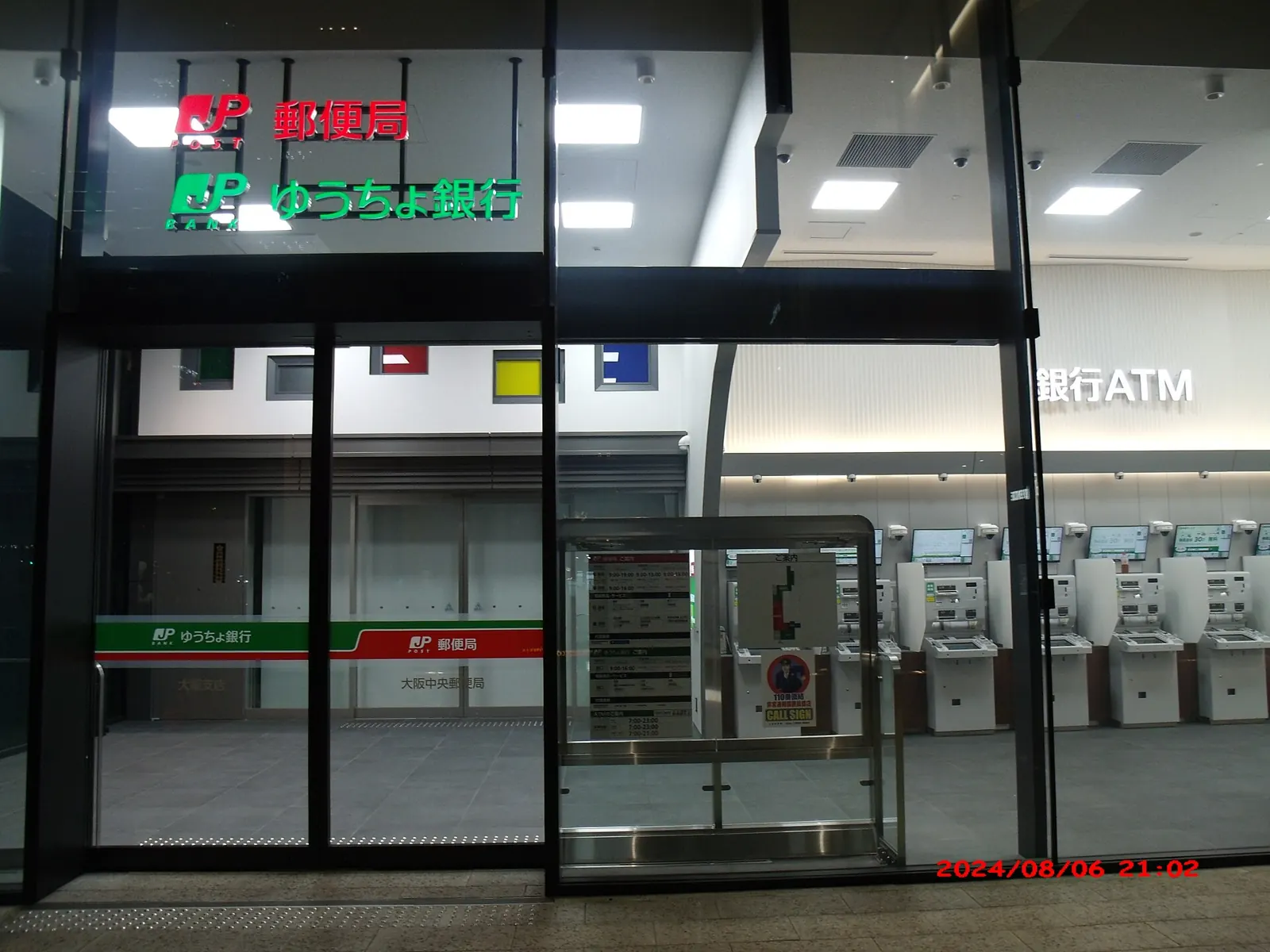
Top photo: “Osaka Central Postal Office & Japan Post Bank Osaka Branch” by Mr.ちゅらさん, CC0, via Wikimedia Commons. Resized and cropped. ↗ CC0